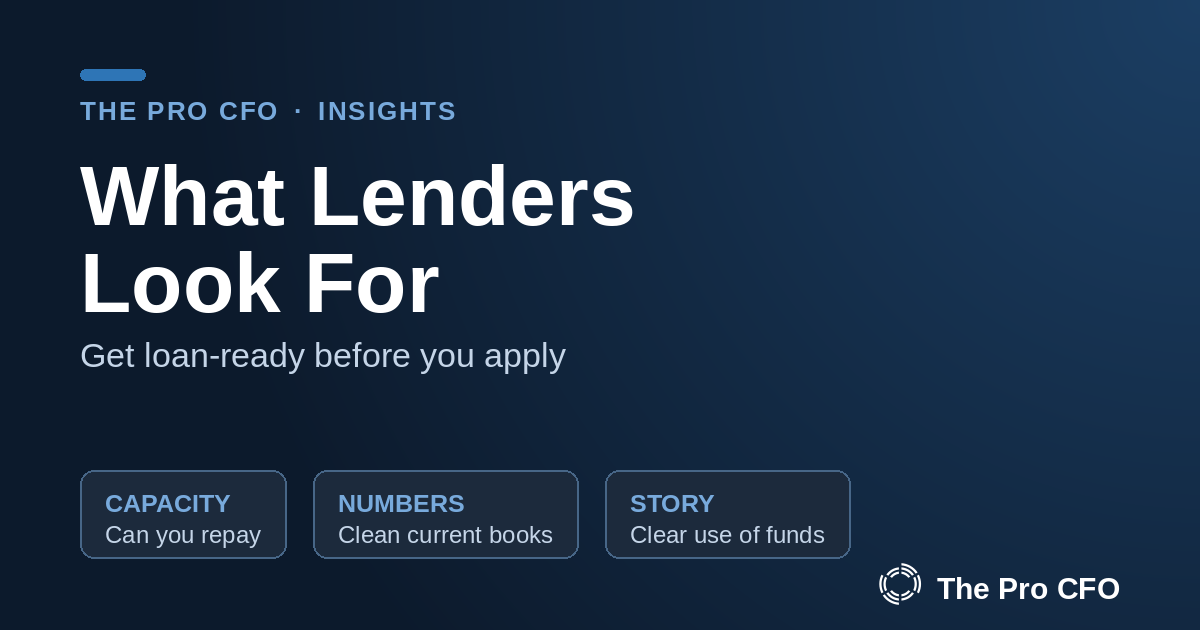
You found the loan you need, filled out the application, and waited. Then the answer came back: declined, or "we need more information." If you've been there, you know the frustration. Most owners assume lenders are looking at their sales. In reality, what lenders look for is much broader: proof that your business can repay the loan, that your numbers are reliable, and that you run the company like you expect to be around in five years.
The good news is that this is mostly a preparation problem, not a luck problem. Lenders follow a predictable playbook. If you know the playbook, you can build your file before you ever apply.
Key Takeaways
- Lenders judge you on repayment ability first. Profit and cash flow matter more than revenue.
- The "5 Cs of credit" (character, capacity, capital, collateral, conditions) are the framework most banks use to decide.
- A debt service coverage ratio (DSCR) of roughly 1.25 or higher is a common benchmark, though each lender sets its own bar.
- Messy or late books are one of the fastest ways to lose a lender's confidence, even if the business is healthy.
- Start getting loan-ready 3 to 6 months before you need the money.
What Lenders Look For: The 5 Cs of Credit
Nearly every bank, credit union, and SBA lender uses some version of the same five-part test. It's worth knowing, because each "C" maps to something you can actually improve.
Character: Can they trust you?
Character is your track record. Lenders look at your personal and business credit history, how long you've been in business, and whether your story holds together. Late payments, unexplained gaps, and sloppy paperwork all chip away at it.
Capacity: Can the business repay the loan?
This is the big one. Capacity is your ability to generate enough cash to cover the new payment on top of everything you already owe. We'll dig into the math below.
Capital: Do you have skin in the game?
Lenders want to see that you've invested your own money and kept profits in the business. A company with healthy equity is a safer bet than one running entirely on borrowed money.
Collateral: What backs the loan?
Collateral is the secondary way out if things go wrong: equipment, real estate, receivables, or a personal guarantee. Know what you can and can't pledge before you apply.
Conditions: Why do you need it, and what's the environment?
Lenders ask what the money is for and how your industry looks. "Buy equipment that will bring in new revenue" is a stronger answer than "cover a rough patch."
The Numbers Lenders Check First
Behind the 5 Cs is a short list of financial statements and ratios. These are the first things an underwriter opens.
Profit and loss statements
Expect to provide two to three years of P&Ls plus a current year-to-date version. Lenders look for stable or growing profit, sensible margins, and no big unexplained swings. If you need a refresher on reading yours, see how to read a P&L like a CFO.
Balance sheet
Your balance sheet shows what you own, what you owe, and what's left over. Lenders scan it for existing debt, owner loans, overdue payables, and whether the numbers actually reconcile to your bank accounts. Our guide on reading a balance sheet explains what each section is telling you.
Debt service coverage ratio (DSCR)
DSCR compares the cash your business earns to the total debt payments it owes. The simple version:
- DSCR = cash available for debt payments ÷ total yearly debt payments
- A result of 1.0 means you only just cover your payments.
- Many lenders like to see around 1.25 or higher, which gives them a cushion.
If your DSCR is thin, a loan that looks affordable to you may still look risky to them.
Cash flow and cash on hand
Lenders also care about your bank balances and trends. Steady deposits and a reasonable cash cushion say you can absorb a slow month. A cash flow forecast showing how the new payment fits in is one of the most persuasive documents you can hand over.
Where Owners Get Declined (and How to Avoid It)
Most denials trace back to a handful of fixable problems.
Books that are late or don't reconcile
If your records are months behind or your balance sheet doesn't match your bank statements, an underwriter has no reason to trust any number in the file. Clean, current books are the foundation of small business loan readiness.
Personal and business finances mixed together
Paying personal expenses from the business account makes profit hard to read and raises questions. Separate them well before you apply.
Too much existing debt
Stacking a new payment on top of heavy obligations can push your coverage ratio below what a lender will accept. Know your total debt payments before you ask for more.
A vague plan for the money
"Working capital" with no explanation is a red flag. Be specific about what you'll buy, what it costs, and how it produces cash to repay the loan.
Tax filings that don't match your books
Lenders compare your financial statements to your tax returns. If they tell different stories, expect questions. Talk with your CPA about any differences so you can explain them clearly.
Your Loan-Readiness Checklist
Use this list as a starting point 3 to 6 months before you plan to apply.
Gather the documents
- Two to three years of business tax returns (from your CPA) and personal returns for owners
- Year-to-date and prior-year P&L and balance sheet
- Recent bank statements
- A schedule of current debts with balances, rates, and payments
- A short explanation of the loan purpose and repayment plan
Tighten the numbers
- Get your books fully reconciled and up to date.
- Calculate your DSCR with and without the new loan.
- Build a simple forecast that shows the payment fitting into your cash flow.
- Pay down or clean up any overdue payables and credit issues.
Prepare your story
Write a one-page summary: what the business does, who your customers are, why you need the funding, and how it pays for itself. Short, specific, and backed by numbers.
Conclusion
Lenders aren't trying to say no. They're trying to answer one question with confidence: will this business repay us? Reliable books, healthy coverage, a clear purpose, and a clean story all push the answer toward yes. The owners who get approved on good terms are usually the ones who prepared months in advance.
If you're not sure your financials would hold up under an underwriter's eye, a CFO Navigator engagement can build the forecast and reporting lenders want to see, and our year-end checklist is a good way to get your file in order. Ready to talk it through? Book a consultation and we'll show you where you stand.
This article is for educational purposes only and isn't tax, legal, or financial advice. Talk with your CPA and lender about your specific situation.