Cash got tight, so you opened the P&L and started hunting. The software subscriptions went first, then the contractor you only used twice, then the marketing line because it was big and you could not prove it was working. Four months later expenses were down and so was revenue, and you could not say for certain which cut caused it. That is the trap. Most owners try to reduce business expenses by looking for what is expensive, when the only question that matters is what is expensive relative to what it produces.
The pressure is real and it is not just you. In Small Business Majority's March 2026 Voice of Main Street poll, 64% of small business owners said their expenses had risen over the previous three months. When costs climb across the board, the instinct is to shave a little off everything. That is the one approach guaranteed to weaken the parts of the business you need most.
Key Takeaways
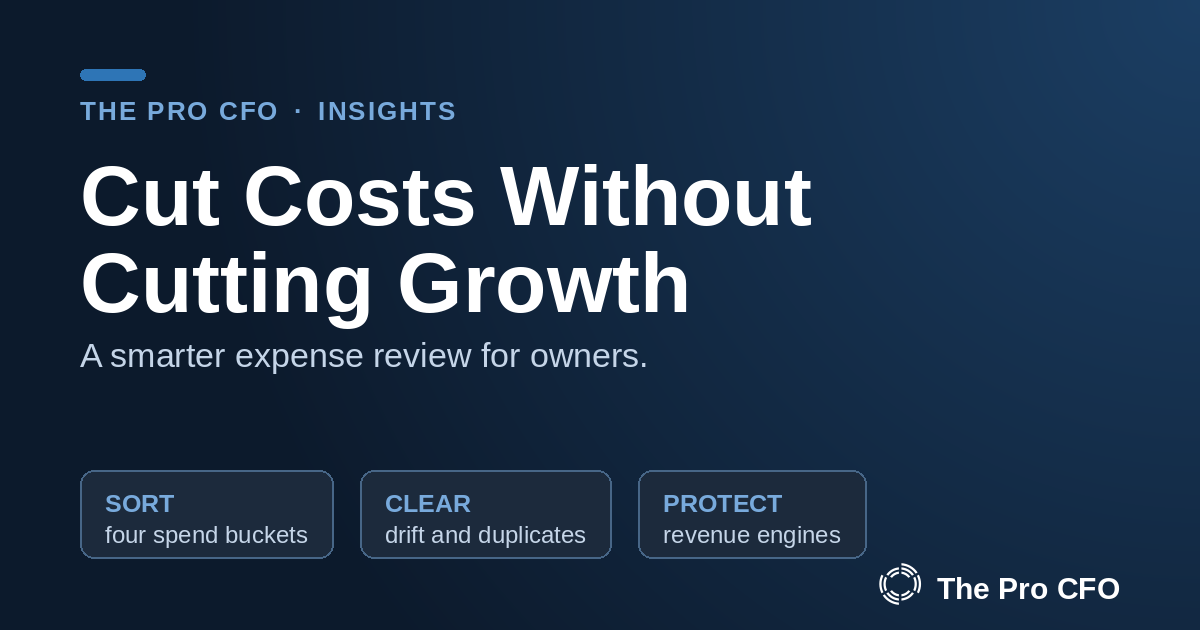
- Cost cutting fails when it treats every expense the same. Sort spending by what it produces, not by what it costs.
- Four categories run the review: growth engines, capacity, obligations, and drift. Only two of them are ever safe to cut fast.
- Vendor and subscription drift is usually 3% to 8% of operating expenses and takes an afternoon to recover.
- Cutting the marketing or sales line is the most common expensive mistake, because the damage shows up two quarters later.
- Set a target dollar amount before you start. A review without a number turns into an argument about whether each item feels necessary.
Why Most Cost Cutting Backfires
The typical expense review starts with the P&L sorted largest to smallest. That sorting is the problem. It ranks spending by size, and size tells you nothing about value.
It punishes the lines that make money
Payroll and marketing are usually the two biggest numbers on the page, which makes them the first targets. They are also the two lines most directly tied to future revenue. Cutting a salesperson saves a known amount today and costs an unknown amount for the next year. The savings are easy to measure and the damage is not, so the cut looks smart on paper for about two quarters.
It confuses a cash problem with a cost problem
Sometimes the business does not have an expense problem at all. It has a collection problem, a pricing problem, or a mix problem. If your customers pay in 62 days and your terms say 30, no amount of expense cutting fixes the squeeze. Before you cut anything, confirm the money is actually leaking out through expenses and not sitting in aged receivables or in work you priced too low.
It happens once, under pressure
Panic reviews are one-time events. They cut deep, everyone feels the pain, and eighteen months later the spending has crept back because nothing changed structurally. A scheduled quarterly review cuts less each time and holds.
The Four-Category Expense Review
Before you decide anything, put every recurring expense into one of four buckets. Do this in a spreadsheet with three columns: vendor, monthly cost, category.
1. Growth engines
Spending that creates or protects revenue. Sales compensation, marketing that you can trace to leads, the tools your revenue team actually uses daily, customer success. These are the last things you touch, and when you do touch them, you reduce the ones with the weakest evidence of return, not the ones with the biggest number.
2. Capacity
What it costs to deliver the work you have already sold. Production labor, direct materials, subcontractors, delivery software. Cutting here is not cost reduction, it is capacity reduction, and it shows up as missed deadlines and churn. If capacity costs are too high as a percentage of revenue, the answer is usually pricing or efficiency, not elimination. Your gross margin versus net margin split will tell you which one you are dealing with.
3. Obligations
Rent, insurance, debt service, required software, licensing. Mostly fixed in the short term, but not permanently fixed. These are renegotiation targets, not cutting targets, and the negotiation happens on the renewal calendar rather than in a panic.
4. Drift
Everything the business bought for a reason that no longer applies. Duplicate tools, seats for people who left, annual plans nobody remembers approving, that second project management app three people still use out of habit. Drift is pure recovery. Cut it hard and cut it now.
Where the Money Actually Hides
When we run this review with clients, the recoverable money shows up in the same handful of places nearly every time.
- Software seats and duplicates. Pull twelve months of card and bank statements and list every recurring charge. Owners routinely find 3% to 8% of operating expenses in tools they forgot about, downgraded plans they never actually downgraded, and overlapping products.
- Merchant processing and bank fees. Rarely reviewed after setup, and often negotiable once you have volume history to point at.
- Insurance and benefits. Quoted once at formation, renewed automatically for years. A re-shop at renewal is free to run.
- Under-used contractors and retainers. A monthly retainer for occasional work should usually be project-based.
- Shipping, freight, and supply pricing. Vendors set your pricing tier when you were smaller. Very few of them volunteer to move you up.
- Unmanaged interest. Balances carried on high-rate credit that could sit on cheaper debt. Interest is an expense you can reduce without cutting anything operational.
How to Run the Review in a Week
The process matters more than the spreadsheet. Give it five focused days.
- Set the target first. Decide the dollar amount you need to remove per month before you look at a single line. Without a number, every item feels defensible and nothing gets cut.
- Pull twelve months, not one. A single month hides annual charges and seasonal spikes.
- Categorize everything into the four buckets. No line goes uncategorized, including the small ones.
- Clear all drift immediately. No debate required. Cancel it and count the savings.
- Build the renegotiation list from obligations, sorted by renewal date, and put each date on the calendar.
- Apply evidence tests to growth engines last. For each one ask what stops happening if this goes away, and how quickly you would know. Anything you cannot answer gets reduced, not eliminated, so you can measure the effect.
- Write down the expected savings per line and check the actual result in 60 days. Expense reviews are famous for savings that never show up in the bank account.
Keep the tax angle out of the decision. When a cut has tax implications, note it and hand it to your CPA rather than letting a tax assumption drive an operating decision.
Making the Savings Stick
Recovered money leaks back out unless something changes structurally.
- One approver for new recurring spend. Most drift enters through small, individually reasonable decisions.
- A quarterly fifteen minute subscription audit. Short and scheduled beats long and reactive.
- A cost ceiling as a percentage of revenue, not a fixed dollar cap, so spending scales with the business instead of getting frozen.
- Track the savings in your monthly review. If cuts are not visible in your budget versus actual variance, they are not real yet.
Conclusion
You do not reduce business expenses by finding the biggest numbers. You do it by separating spending that produces something from spending that used to. Sort every line into growth engines, capacity, obligations, and drift. Clear the drift this week, put the obligations on a renegotiation calendar, protect capacity, and touch the growth engines last and carefully. Done that way, a smart expense review usually improves margin without costing you a single customer.
If your books are not clean enough to categorize spending reliably, start there. Our Foundations service exists to get the accounting accurate enough that decisions like this rest on real numbers instead of guesses.