You know you need help with your numbers, but the titles all blur together. A bookkeeper, an accountant, a CFO, a "fractional" version of that CFO. They sound interchangeable, and most business owners end up either paying for the wrong one or hiring three people to do what they think is one job. The question behind the question is usually simple: who keeps me out of trouble, and who actually helps me grow? Understanding the real difference in the fractional CFO vs bookkeeper vs accountant lineup is the fastest way to stop overpaying for the work you don't need and start getting the help you do.
The short version: these three roles answer three different questions about your money. Once you see that, the choice gets a lot easier.
Key Takeaways
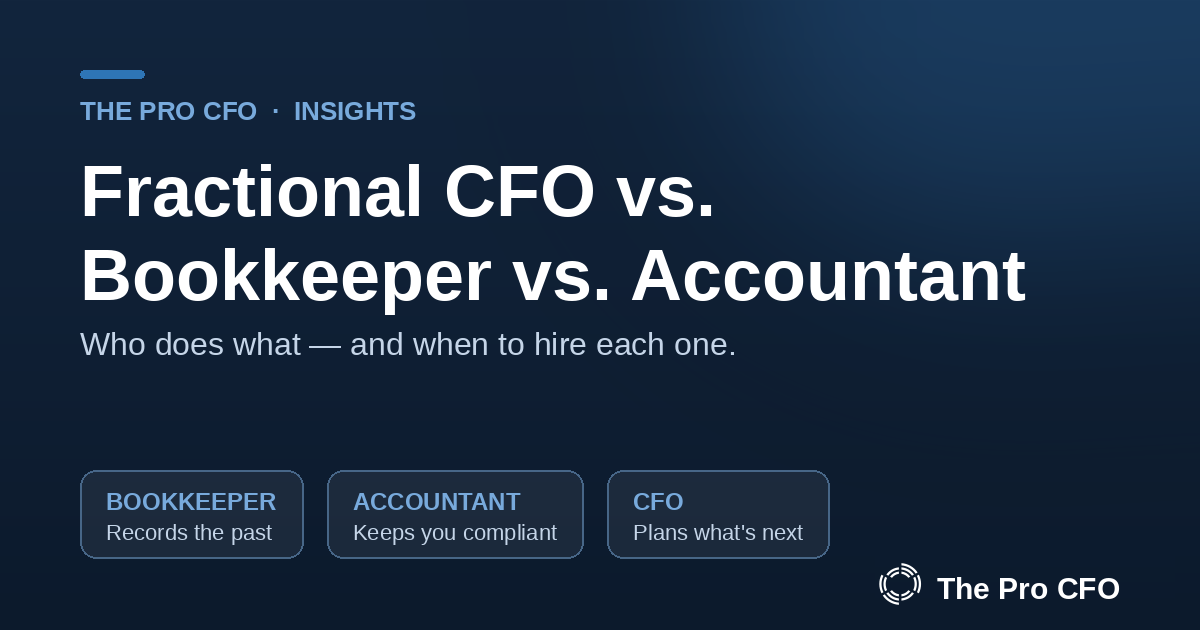
- A bookkeeper answers "what happened," an accountant answers "what do we owe and is it compliant," and a CFO answers "what should we do next."
- Most businesses need a bookkeeper from day one, an accountant or CPA by tax time, and a CFO when decisions start carrying real financial risk.
- A fractional CFO gives you senior-level strategy on a part-time basis, typically for a fraction of the cost of a full-time hire.
- Hiring the wrong role first is the most common and most expensive mistake, usually paying for strategy when the books aren't even clean yet.
- The three roles work best as a stack, not a choice. Each one depends on the layer beneath it.
The Three Roles, in Plain English
Think of your finances as a building. Each role works on a different floor, and you can't skip the lower ones.
The bookkeeper records what happened
A bookkeeper handles the day-to-day. They record every transaction, reconcile your bank and credit card accounts, manage what you owe (accounts payable) and what you're owed (accounts receivable), and keep your general ledger accurate. Their job is history: making sure that when you look at last month, the numbers actually reflect reality.
If your books are a mess, nothing above this floor can be trusted. A forecast built on bad data is just a confident guess. This is why clean books are the foundation for every other financial decision, and why we treat them as non-negotiable before any strategy work begins. (If you're not sure yours qualify, our small business bookkeeping checklist is a good gut check.)
The accountant explains and keeps you compliant
Where a bookkeeper records the "what," an accountant (often a CPA) handles the "why" and the "what now." They prepare and file your tax returns, advise on entity structure, and keep you compliant with tax law. A good CPA is worth their weight at tax time and when the IRS or a lender comes asking questions.
What an accountant usually is not built for is ongoing, forward-looking strategy. Most CPAs are focused on compliance and the prior year, not on whether you should take that big contract or how next quarter's cash will hold up. That's not a knock on them. It's a different job.
The CFO decides what to do next
A Chief Financial Officer looks forward. They build the forecast, manage cash flow strategy, set and watch the KPIs that actually predict your future, and sit in the room when you're deciding whether to hire, expand, raise prices, or take on debt. The bookkeeper and accountant tell you where you've been. The CFO helps you decide where to go.
The catch is that a full-time CFO is expensive. Industry data puts the average full-time CFO salary around $229,000, with total employer cost often landing between $270,000 and $320,000 a year once benefits and payroll taxes are in. For a business doing a few million in revenue, that math rarely works.
Fractional CFO vs Bookkeeper: Why People Confuse Them
Here's where the most expensive confusion happens. Owners often ask whether they should hire a bookkeeper or "someone more strategic," as if it's an either/or. In the fractional CFO vs bookkeeper question, the honest answer is that you almost certainly need both, just not at the same intensity.
They sit at opposite ends of the same pipeline
A bookkeeper feeds the machine with accurate data. A fractional CFO uses that data to make decisions. Ask a bookkeeper to build your growth strategy and you'll get a tidy ledger and a blank stare on the strategy. Ask a CFO to categorize 800 transactions a month and you'll burn premium dollars on data entry. Each is excellent at their floor and miscast on the other's.
A fractional CFO is the part-time version of the strategy role
"Fractional" simply means you get a senior finance leader for the slice of time you actually need, often a few days a month rather than full-time. You get the forecasting, the cash strategy, and the in-the-room judgment without the six-figure salary. It's the same reason you don't hire a full-time lawyer to review the occasional contract. For a deeper look at the strategic side specifically, our fractional CFO service page breaks down what that engagement actually covers.
What Each Role Costs
Rough ranges, because the real number depends on your transaction volume and complexity. Hand the specifics to your CPA for anything tax-related, but here's the shape of it:
- Bookkeeper: often a few hundred to roughly $2,000 a month depending on volume, or an hourly rate for lighter needs.
- Accountant / CPA: frequently project-based or annual. Tax prep and filing might run anywhere from several hundred to several thousand dollars a year, more with complexity.
- Fractional CFO: commonly a monthly retainer that's a meaningful fraction of a full-time salary. The point is senior judgment at part-time cost.
The mistake isn't spending money on one of these. It's spending CFO money on bookkeeping tasks, or expecting a bookkeeper's rate to buy you strategy.
When to Hire Each One
The rough sequence most healthy businesses follow:
Start with a bookkeeper
From close to day one. The moment money is moving in and out, you need accurate records, both to make decisions and to survive tax season. Trying to "catch it all up later" is how owners end up paying for an expensive cleanup project instead of clean monthly books.
Add an accountant as you formalize
As soon as taxes get real, which for most owners is the first profitable year or the first time they form an LLC or S-corp. A CPA keeps you compliant and helps you avoid leaving money on the table or stepping on a landmine.
Bring in a fractional CFO when decisions carry real risk
This is less about a revenue number and more about complexity and stakes. Common signals: you're profitable on paper but always short on cash, you're considering a big hire or a loan, growth has stalled and you can't see why, or you're making seven-figure decisions on gut feel. If you're routinely guessing about the future, that's the floor a CFO is built for. (The classic symptom is a business that can't forecast its way out of a slow season. We wrote about exactly that in why most small businesses fail at forecasting.)
The Stack, Not the Choice
The biggest reframe: this was never a competition. The strongest small businesses run all three as a stack. The bookkeeper keeps the data clean. The accountant keeps you compliant and tax-smart. The CFO turns that trustworthy data into decisions. Pull out the bottom layer and the top one collapses, which is why "I'll just hire a CFO" rarely works if the books are a mess.
The reason "led by a CFO, not a bookkeeper" matters is that strategy has to sit on top of solid bookkeeping, never instead of it. You want both done well, by the right person, at the right cost.
Conclusion
The fractional CFO vs bookkeeper vs accountant decision stops being confusing the moment you map each role to a question. What happened? Your bookkeeper. What do we owe and is it compliant? Your accountant. What should we do next? Your CFO. Most owners don't need to choose one. They need to build the stack in the right order and avoid paying strategy rates for data entry, or expecting data entry rates to buy strategy.
If your books are clean and you've started making decisions that feel too big to guess on, that's usually the sign you're ready for the top floor. Book a consultation and we'll help you figure out which role you actually need next, no pressure to buy the whole building before you're ready.